
Fears & Insecurities Specialization
Professional Certification in Psychoanalysis
The Fears & Insecurities specialization certifies you to work with phobias, chronic self-doubt, and confidence deficits — and, just as deliberately, to confront the fears that quietly run your own life. You will learn to map where a fear lives in the body, trace an insecurity back to its origin, and help a client rebuild a steadier sense of self. It is a completion-based professional certification from Therapist University in Miami: serious training, an honest scope, and tools you can use the same week.
For your practice
Work with phobias, self-doubt, and confidence deficits — techniques to rebuild a client's sense of self.
For your own life
Name the fears that run your life and the insecurities that hold you back — and move past them.
What you'll learn
- 1The Anatomy of Fear and Insecurity. Distinguish rational fear, specific phobia, social fear, and generalized self-doubt. Map the fight-flight-freeze response and how avoidance quietly trains the nervous system to expect threat where none exists.
- 2Tracing the Origin of the Inner Critic. Use psychoanalytic and history-taking technique to locate where an insecurity was learned — early comparison, criticism, or shame — and how it became an internalized voice the client now mistakes for truth.
- 3Working With Phobias and Avoidance. Build a graded exposure-informed framework: fear hierarchies, paced approach, and tolerating discomfort safely. Learn the boundaries of this work and when a specific phobia warrants referral to a licensed clinician.
- 4Rebuilding the Sense of Self. Confidence-restoration technique: separating self-worth from performance, dismantling impostor patterns, and helping a client gather evidence against their own catastrophic predictions.
- 5The Session Protocol: First Contact to Stability. A full arc — intake, naming the fear, contracting goals, between-session practice, and measuring change — so each engagement has structure rather than open-ended reassurance.
- 6Your Own Fears as a Practitioner. Turn the work inward: name your avoidance and self-doubt, apply the same strategies you offer clients, and protect against projecting your insecurities onto the people you serve.
Who this is for
- Practicing counselors and coaches who keep meeting clients frozen by social anxiety, performance fear, or a harsh inner critic and want a structured way to work with it
- Helping professionals adding a focused phobia-and-confidence track to an existing practice, with a clear scope of practice and a session protocol
- People who recognize their own avoidance, impostor feelings, or fear of judgment, and want practical strategies to move past them
- Anyone drawn to the psychoanalysis of fear — how dread, shame, and self-doubt form, persist, and finally loosen their grip
What you'll be able to do
- Conduct a structured assessment that separates phobia, social fear, and chronic insecurity, and tailor the approach to each
- Run an exposure-informed, paced program for avoidance and fear, with explicit limits and clear referral criteria
- Apply confidence-rebuilding and inner-critic techniques to strengthen a client's sense of self over a defined session arc
- Recognize and manage your own fears and insecurities so they sharpen rather than distort your practice
What's included
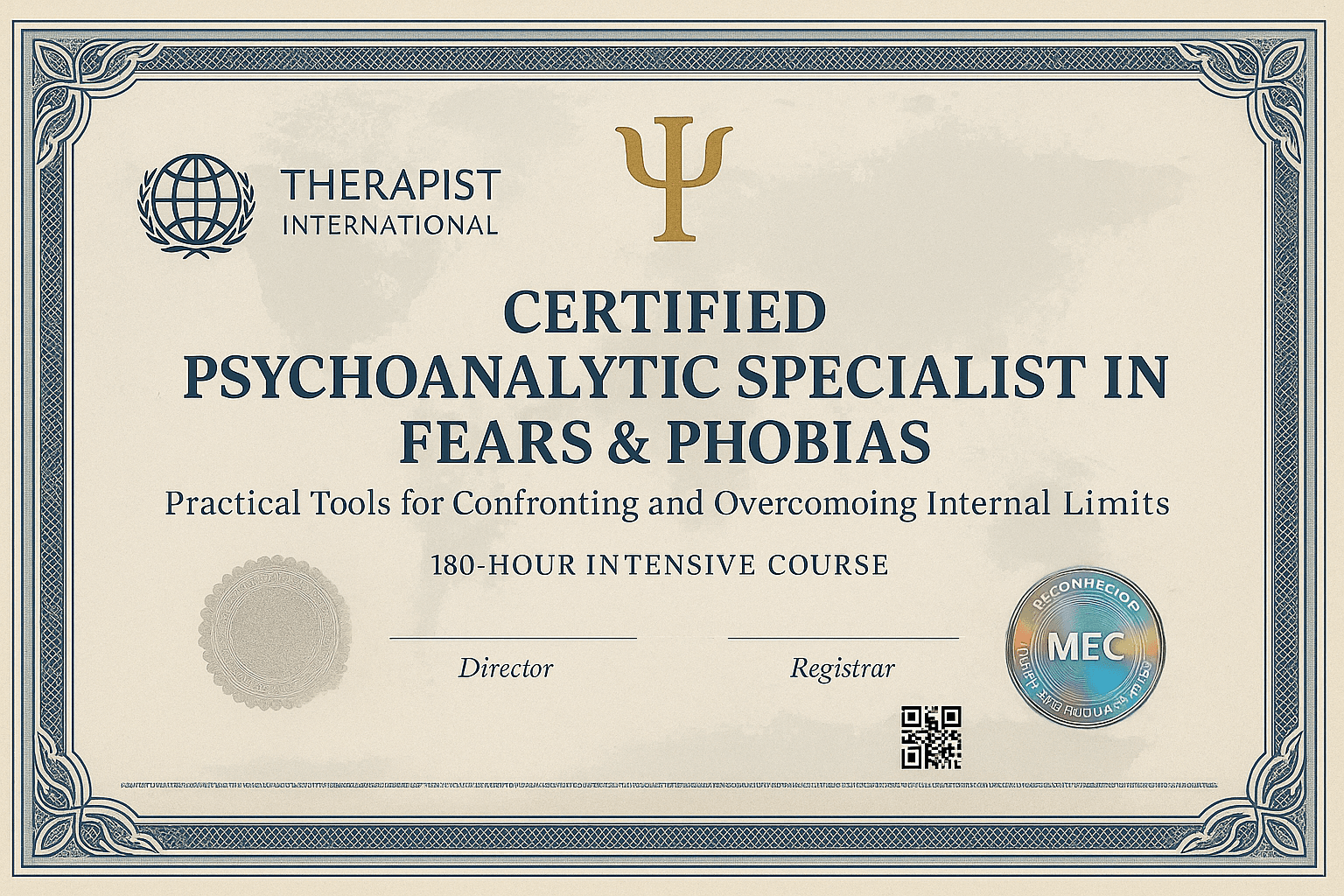
Globally valid certificate
An official certificate of completion you can show and verify.
Professional register entry
Your name in the Therapist University professional register.
Practitioner ID & badge
Your official, verifiable practitioner ID and digital badge.
This is a completion-based professional certification in working with fears and insecurities — not a state license, an accredited degree, or a guarantee of any clinical or financial outcome.
Questions
Is this a license to treat anxiety disorders or phobias clinically?
No. This is a completion-based professional certification from Therapist University, not a state license, an accredited degree, or transfer credit. It qualifies you to work with fear, self-doubt, and confidence concerns within a clearly defined scope, and to recognize when a presentation — such as a severe or disabling phobia — should be referred to a licensed clinician.
Will this certification fix my own fears and insecurities?
It is not a cure, and it does not diagnose. The personal track gives you the same frameworks and practical strategies you will use with clients, applied to your own avoidance, impostor feelings, and self-doubt. Most people use it to understand where their fears come from and to work with them more deliberately.
What do I receive when I complete the program?
On completion you receive the Fears & Insecurities professional certification, an entry in the Therapist University professional register, and a practitioner ID badge you can display. These confirm you finished this specialized training — they are not academic credentials or accreditation from CHEA or the USDE.
Is the Fears & Insecurities specialization valid in my country?
It is a globally valid certificate of completion, used by graduates across 130+ countries. It certifies that you trained and qualified through Therapist University — it is not a government-issued license. See our Recognition & Validity page for the honest specifics.
What exactly do I receive?
The certificate of completion, an entry in our professional register, and your official practitioner ID badge — all publicly verifiable.
Become a certified Fears & Insecurities specialist
$297 · certificate, professional register entry, and practitioner ID included.